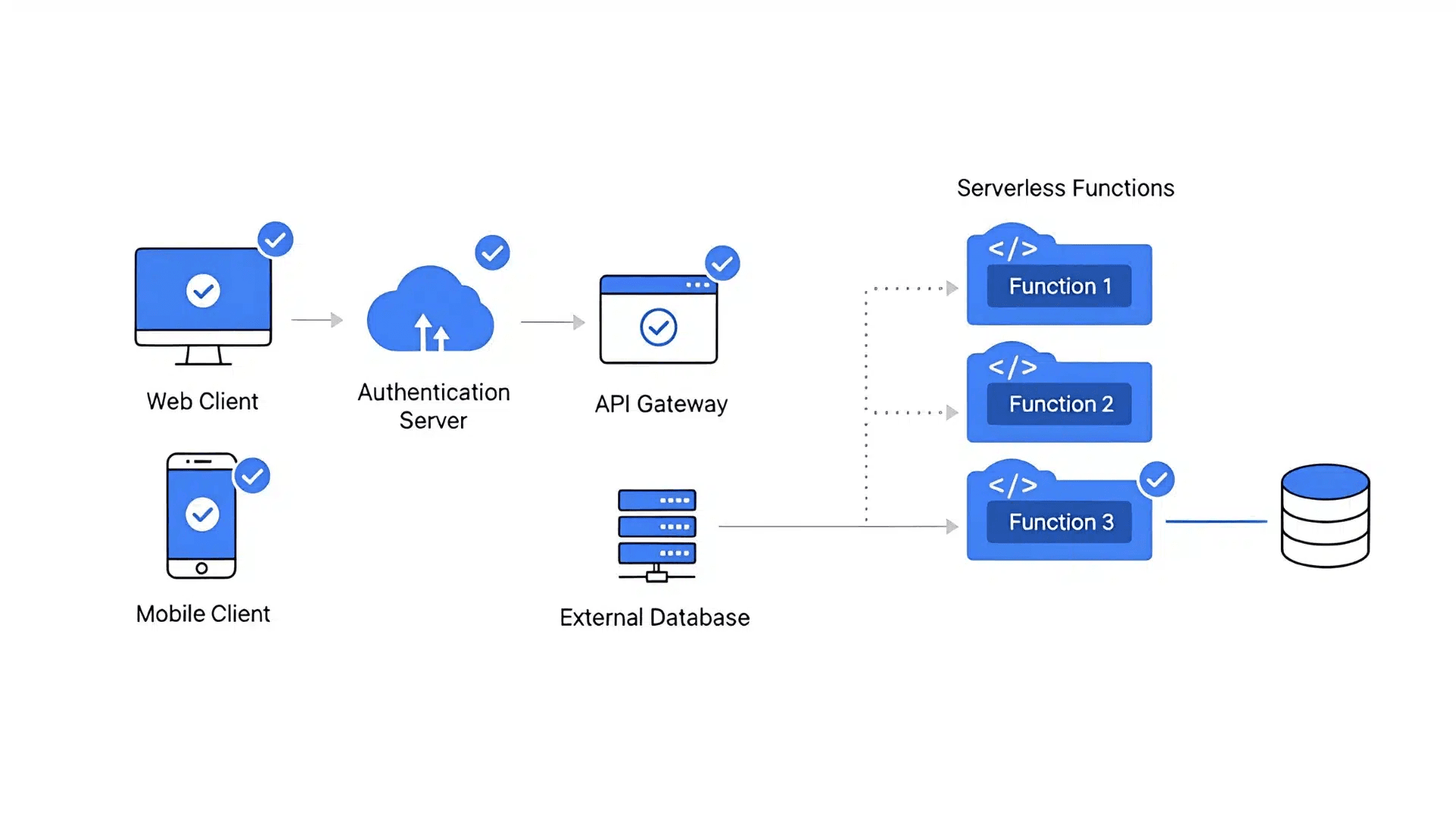
Edge functions are no longer a novelty. In 2025, they are a practical way to push small amounts of logic closer to users for faster decisions, personalized routing, and low-latency reads. Regional serverless remains the workhorse for business logic, write-heavy operations, and integration with stateful systems. Getting real performance and cost gains means choosing the right runtime for the job, shaping your data flows, and avoiding hidden traps like accidental origin fetch loops or heavy Node dependencies in edge bundles.
If you are optimizing for Core Web Vitals at the same time, pair this guide with Next.js Core Web Vitals in 2025. For metadata, canonical URLs, and crawl signals that complement fast pages, see Next.js SEO Best Practices.
TLDR
- Use the edge for request shaping, geo based decisions, auth preflight, feature flags, and low-latency reads from edge caches or KV.
- Use regional serverless for writes, workflows, payments, and anything that needs strong consistency or heavy libraries.
- Keep edge bundles small and Node free. Prefer Web APIs. Avoid large dependencies and heavy crypto libraries.
- Design for idempotency, retries, and circuit breakers. Measure cold starts and tail latency, not just averages.
A mental model for latency, data, and cost
Think in three zones: user, edge, and region. Each hop adds latency and capability.
User ─► Edge PoP ─► Regional compute ─► Datastores
  ↓        ↓            ↓                ↓
  ms       low ms       10s to 100s ms   variable

Principles:
- Push light decisions to the edge to avoid the regional round trip.
- Keep writes in the region to maintain consistency guarantees.
- Cache aggressively at the edge. Revalidate in the background.
This model keeps you honest about what belongs where. If a function needs Node APIs or a pooled DB connection, it belongs in regional serverless. If it can run on Web APIs with no secret heavy lifting, the edge is a candidate.
For a complementary architecture overview beyond a single app, see Clean Architecture for Fullstack.
Choosing the right runtime in 2025
When the edge shines
- Geo or device based routing, A B testing, and feature gates.
- Auth preflight, token validation, and low-latency personalization using cookies or signed tokens.
- Simple reads backed by edge caches, KV, or CDN stored JSON.
- Streaming responses that should start fast, like incremental HTML or server sent events.
When regional serverless is better
- Anything that writes to relational data with transactions or needs strong consistency.
- Payment handlers and webhooks that must use official SDKs.
- Tasks that require Node specific modules or large binaries.
- Background jobs, scheduled tasks, and long running workflows.
For payment design and compatibility concerns, review Stripe API Versioning Explained and API Versioning and Backward Compatibility.
Platform constraints to respect
- Edge runtimes use Web APIs. No access to Node built ins like fs, net, tls, or native modules.
- Smaller bundle limits and strict execution timeouts. Keep code paths minimal and predictable.
- Limited or different secret management. Prefer short lived tokens and explicit audience scoping.
- Use fetch for external calls. Avoid implicit connection pooling assumptions.
If you are integrating third party models or vector stores, pick connectionless drivers and HTTP friendly SDKs. For grounding and search patterns, see Vector Databases for Semantic Search and RAG for SaaS.
Pattern 1: request shaping at the edge
Use the edge to make the first decision about where a request should go and what payload it carries. This often replaces an origin round trip with a near instant response.
Example: Next.js middleware for geo and features
// middleware.ts
import type { NextRequest } from "next/server";
import { NextResponse } from "next/server";

export const config = { matcher: ["/", "/products/:path*"] };

export const middleware = (req: NextRequest) => {
  const url = req.nextUrl.clone();
  const country = req.geo?.country || "US";
  const flags = req.cookies.get("flags")?.value || "";

  // Simple regional redirect for preview routes
  if (url.pathname.startsWith("/preview") && country !== "US") {
    url.pathname = "/preview-eu";
    return NextResponse.rewrite(url);
  }

  // Feature gate for an experimental product list
  if (flags.includes("new-list") && url.pathname === "/products") {
    url.pathname = "/products-new";
    return NextResponse.rewrite(url);
  }

  return NextResponse.next();
};
Keep the logic tiny. Avoid network calls where possible. If you must call out, set low timeouts and fail open.
Pattern 2: low-latency reads with edge route handlers
Edge route handlers can read from a cache or KV and respond instantly. Writes are delegated to regional compute or queued.
Example: streaming a small payload from the edge
// app/api/hello/route.ts
export const runtime = "edge";

export const GET = async () => {
  const { readable, writable } = new TransformStream();
  const writer = writable.getWriter();
  const enc = new TextEncoder();

  ;(async () => {
    for (const chunk of ["hello", " ", "edge"] as const) {
      await writer.write(enc.encode(chunk));
      await new Promise((r) => setTimeout(r, 40));
    }
    writer.close();
  })();

  return new Response(readable, {
    headers: {
      "content-type": "text/plain; charset=utf-8",
      "cache-control": "public, max-age=30, s-maxage=300",
    },
  });
};
Streaming improves TTFB and perceived performance. For route level performance practices, pair this with Next.js Core Web Vitals in 2025.
Example: HMAC verification with Web Crypto at the edge
// utils/hmac.ts
export const hmacSha256 = async (secret: string, data: string): Promise<string> => {
  const encoder = new TextEncoder();
  const key = await crypto.subtle.importKey(
    "raw",
    encoder.encode(secret),
    { name: "HMAC", hash: "SHA-256" },
    false,
    ["sign"]
  );
  const sig = await crypto.subtle.sign("HMAC", key, encoder.encode(data));
  return [...new Uint8Array(sig)].map((b) => b.toString(16).padStart(2, "0")).join("");
};
Use constant time comparison when possible. If your platform provides a timing safe compare, prefer that. Otherwise compare fixed length hex strings without early returns.
Pattern 3: idempotency for serverless writes
Regional serverless remains the right place for writes. Make handlers idempotent to avoid double charges or duplicate side effects.
// app/api/charge/route.ts
export const runtime = "nodejs"; // or omit to use default regional runtime

type ChargeResult = { status: "ok" | "duplicate" | "error"; id?: string };

export const POST = async (req: Request): Promise<Response> => {
  const key = req.headers.get("Idempotency-Key") || "";
  if (!key) return new Response(JSON.stringify({ error: "Missing Idempotency-Key" }), { status: 400 });

  // Lookup previous outcome in a durable store (e.g., Redis, Dynamo, Postgres)
  const prev = await findIdempotencyRecord(key);
  if (prev) return new Response(JSON.stringify({ status: "duplicate", id: prev.chargeId }), { status: 200 });

  try {
    const chargeId = await createChargeSafely(req);
    await saveIdempotencyRecord(key, chargeId);
    return new Response(JSON.stringify({ status: "ok", id: chargeId }), { status: 200 });
  } catch (err) {
    // Do not save failed attempts so that retries can succeed later
    return new Response(JSON.stringify({ status: "error" }), { status: 500 });
  }
};
For payments and webhooks, version compatibility matters. Review Stripe API Versioning Explained and API Versioning and Backward Compatibility. When integrating Paddle, see Paddle Integration for SaaS.
Pattern 4: edge rate limiting with a remote counter
Sliding window rate limiting at the edge needs a lightweight store. Use a REST Redis service or a KV service. Keep the edge logic tiny and fail safe.
// utils/rateLimit.ts
type RateLimitResult = { allowed: boolean; remaining: number };

export const rateLimit = async (key: string, windowSec: number, max: number): Promise<RateLimitResult> => {
  const now = Math.floor(Date.now() / 1000);
  const bucket = Math.floor(now / windowSec);
  const composite = `${key}:${bucket}`;

  // Example: call a REST endpoint that does INCR with TTL
  const res = await fetch(process.env.UPSTASH_PIPELINE_URL as string, {
    method: "POST",
    headers: { authorization: `Bearer ${process.env.UPSTASH_TOKEN}` },
    body: JSON.stringify({ cmd: "INCR_WITH_TTL", key: composite, ttl: windowSec }),
  });
  const { count } = (await res.json()) as { count: number };
  return { allowed: count <= max, remaining: Math.max(0, max - count) };
};
Call this from middleware or an edge handler. Always return a Retry After header when blocking to guide clients.
Pattern 5: background work without blocking responses
Avoid doing analytics writes or slow third party calls in user critical paths. Send them to a queue or a dedicated endpoint with a short timeout.
// app/api/track/route.ts
export const runtime = "edge";

export const POST = async (req: Request) => {
  const payload = await req.text();
  // Fire and forget with tight timeout. Do not block the response.
  fetch(process.env.METRICS_URL as string, {
    method: "POST",
    body: payload,
    headers: { "content-type": "application/json" },
    // Some platforms support a short timeout or keepalive. Keep this non blocking.
  }).catch(() => {});
  return new Response(null, { status: 202 });
};
For real durability use a queue. For an end to end deployment alternative that gives you more control, read Deploy Next.js on a VPS.
Architecture diagrams
Read at the edge, write in the region
Client
  │
  ▼
Edge function ──► Edge cache or KV
  │               │
  │               └── Miss ──► Regional serverless ──► DB
  ▼
Response in ms
Write behind queue
Client ─► Edge function ─► Queue ─► Regional worker ─► DB
   │         │   202          │          │             │
   └─────────┴────────────────┴──────────┴─────────────┘

Pros: low latency for the user and resilient writes.
Cons: eventual consistency for derived reads.
Data strategies that actually work
- Separate read and write paths. Read through the edge with strong cache headers and short revalidation.
- Use tag or key based invalidation. Revalidate in the background. Consider fanout invalidations from regional compute.
- Prefer connectionless drivers for databases in serverless. Examples include Neon for Postgres or serverless friendly MySQL drivers.
- For search and retrieval, use hosted vector stores or serverless plans with HTTP APIs. See Document Q and A with Next.js + LangChain and Integrate OpenAI API in Next.js.
Caching and validation in practice
Use HTTP caching with ETag and Cache-Control first. Keep cache rules simple and predictable.
// utils/httpCache.ts
export const respondWithCache = (body: string, etag: string, req: Request): Response => {
  const inm = req.headers.get("if-none-match");
  if (inm && inm === etag) return new Response(null, { status: 304 });
  return new Response(body, {
    status: 200,
    headers: {
      etag,
      "cache-control": "public, max-age=60, s-maxage=300, stale-while-revalidate=600",
      "content-type": "application/json; charset=utf-8",
    },
  });
};
For progressive enhancement and resilient user experiences on flaky networks, read Offline Ready PWAs.
Security basics at the edge and in region
- Validate and normalize inputs early at the edge. Drop obviously invalid requests.
- Verify signatures with Web Crypto at the edge or SDK based verification in region for providers that require Node.
- Use short lived tokens and explicit audiences. Avoid global wide scope secrets at the edge.
- Apply rate limits and abuse detection at the edge to reduce load on the region.
Observability that survives scale
- Generate a correlation id at the edge. Forward it as a header to all downstream calls and logs.
- Sample traces. Focus on tail latency and error classes that affect users.
- Emit structured logs. Separate debug fields behind a flag to avoid bloating logs.
// utils/correlation.ts
export const generateCorrelationId = (): string => crypto.randomUUID();

export const withCorrelation = (headers: Headers, id?: string): Headers => {
  const h = new Headers(headers);
  h.set("x-correlation-id", id || generateCorrelationId());
  return h;
};
Cost awareness and cold starts
- Keep edge bundles small. Remove unused dependencies and deep import only what you need.
- Split regional functions by responsibility so hot paths stay warm and small.
- Prefer HTTP based SDKs over heavy polyfilled clients in the edge.
- Measure P95 and P99 latency. Cold starts show up in tails, not averages.
Pair these with a performance checklist in reviews. For a broader performance mindset in React apps, read Next.js Core Web Vitals in 2025.
Migration playbook
- Inventory routes and handlers. Label by read heavy versus write heavy and by dependency type.
- Move pure read handlers with Web API compatible dependencies to the edge.
- Keep or move write handlers to regional serverless. Add idempotency and retries.
- Add middleware for request shaping and lightweight auth preflight.
- Add observability: correlation ids, sampling, and alerts on tail latency.
- Rehearse failures. Rate limit surges, block third party outages with circuit breakers, and verify fallback paths.
FAQs
Is the edge always faster?
No. If your logic immediately calls a regional origin with a slow dependency, the edge adds another hop. Use the edge when you can decide or respond locally, cache effectively, or reduce downstream load.
Can I run SDK X at the edge?
Only if it uses Web APIs and does not rely on Node built ins. Prefer vendor REST endpoints or web compatible clients. If the SDK pulls in heavy crypto or native modules, keep it in regional serverless.
What about consistency?
Use eventual consistency for derived reads. For critical invariants, keep the source of truth in the region and propagate updates via events or invalidation. Monitor divergence and build idempotent replays.
Conclusion
Edge functions and regional serverless are complementary. Use the edge for small, fast decisions and reads. Use the region for durable writes and complex business logic. Keep edge bundles small, design idempotent handlers for writes, and measure tail latency. With a few disciplined patterns, you get faster pages, lower costs, and better resilience without turning your system into a distributed debugging exercise.
To keep exploring, read the performance guide for pages in Next.js Core Web Vitals in 2025 and ship clean crawl signals with Next.js SEO Best Practices. For data heavy apps, see Vector Databases for Semantic Search, RAG for SaaS, and integration patterns in Integrate OpenAI API in Next.js.
Actionable takeaways
-
Split by runtime. Move pure reads and request shaping to the edge. Keep writes and heavy SDKs in regional serverless with idempotency.
-
Keep edge small. Audit imports, prefer Web APIs, and measure tail latency. Add rate limits and correlation ids.
-
Cache first. Use strong HTTP caching with revalidation. Invalidate via tags or keys from regional handlers. Test failure paths and verify fallbacks.